
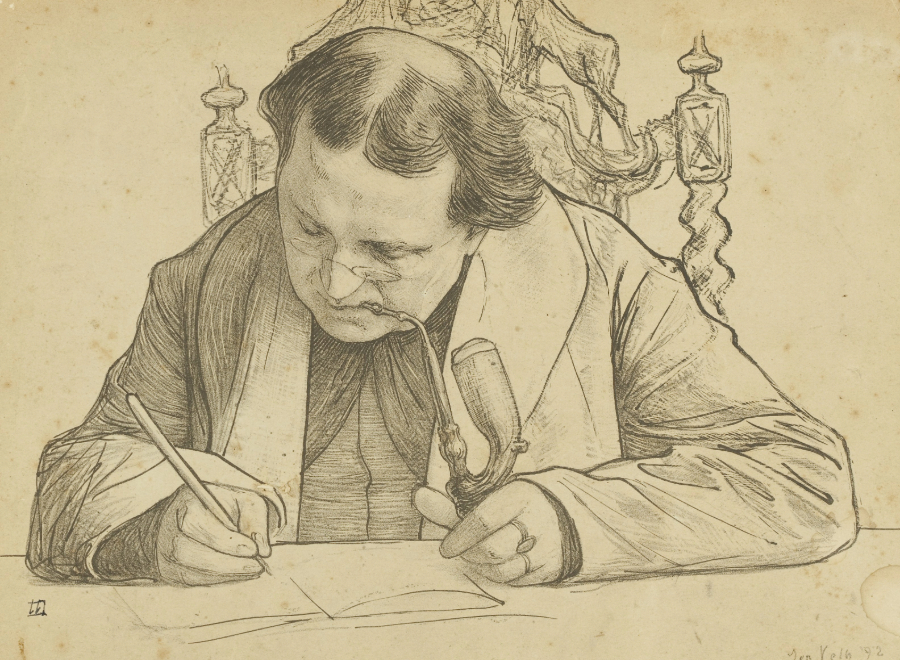
For most of his career and for more than half a century, Abraham Kuyper (1837–1920) worked mainly as a journalist. This remarkable fact has largely been overlooked in the century since his death. Even more surprising is that Kuyper’s journalistic activity focused on daily news, not timeless musings. And not only was his journalistic output immense—tens of thousands of articles in both his daily and weekly newspapers —but he also made an outstanding contribution to the burgeoning profession of journalism. The last quarter of the nineteenth century marked what has been called “the invention of journalism” (see e.g. Chalaby 1998), and Kuyper contributed to this development as a leader of the national and even international journalists’ movement and with theoretical essays on the new mass media—far ahead of his time.
Kuyper’s passion for journalism was shaped by two themes that dominated his life: theology and politics. These interests led him to devote his working life largely to publishing. He limited himself in a way unique for the time to two specific print media: as a politician Kuyper primarily voiced his ideas in his own daily newspaper, De Standaard, and as a theologian he wrote first and foremost for his own weekly (Sunday) newspaper, De Heraut.
He worked alternately on these two publications for literally seven days a week. His total production for the weekly newspaper was not much smaller than that for the daily, because he supplied more columns for De Heraut. His main articles usually appeared in De Standaard on fixed days—Monday, Wednesday, and Friday—while his output for De Heraut usually amounted to three or four different articles also written during the week. He invariably wrote the meditation for De Heraut on Sunday mornings when the rest of his family was in church or when he was having a day of rest during his travels.
This essay not only offers an overview of Kuyper’s immense journalistic output but also outlines his work for the fledgling journalists’ movement in the Netherlands and internationally and, most importantly, his theoretical reflections on the “new power” of journalism. For Kuyper journalism, along with its twin public opinion, constituted a sovereign sphere of its own, and on occasion he wrote about it in those terms.

Kuyper’s substantial contributions on these and related themes, twenty-two essays in total, have been translated and published in On Charity and Justice (Kuyper 2022) with short introductions by me. They constitute four sections of that volume:
-
“Is Error a Punishable Offense?” (series of sixteen essays, 1874)
-
“Free Speech and the Free Word” (series of four essays, 1895)
-
“Celebrating Twenty-Five Years of De Standaard” (1897)
-
“The Press as the Apostle of Peace” (1913)
These writings explicate Kuyper’s theory of journalism that informs the present essay. In his essays Kuyper developed a theory of the press known today as “Involved Journalism” or “Journalism of Attachment” and propounded it with a wealth of practical knowledge.
Kuyper’s work as editor-in-chief, a position he held for decades at De Standaard and De Heraut, has long been underexposed. The prevailing image of Kuyper has long been that of a university professor performing side jobs in journalism. Here are three reasons to view him differently:
I. Kuyper Was an Accomplished Journalist
Kuyper was a highly productive journalist, producing a vast output by studiously writing in the morning hours from nine to half past twelve. In half a century he delivered more than 12,500 lead articles and 16,800 “asterisms” (also known as three-stars, shorter or longer commentaries on the daily news published on the front pages)—someone with inside knowledge counted them—for De Standaard and De Heraut.
By any standard that production was prolific, and it was also influential: Kuyper set the tone throughout the anti-revolutionary movement. De Standaard was his main political pressure tool, and De Heraut was also a formidable weapon in the church, right down to circles of Dutch emigrants in North America. Even Woodrow Wilson is said to have read De Heraut (“The Herald”) in the White House.
The journalist in Kuyper was born when he, still a pastor in Utrecht, began writing for the then weekly De Heraut in the summer of 1869. He started out as a political editor and continued as editor-in-chief ad interim from the fall of 1870. Once he had formally become editor-in-chief in January 1871 he confirmed the course that had already been informally set: De Heraut acquired a distinctly anti-revolutionary sound. This became the testing ground for the hoped-for realization of an anti-revolutionary daily newspaper. That daily became a reality on April 1, 1872, and for that daily Kuyper would provide the lion’s share of his journalistic production.
From the very beginning Kuyper contributed to “his own” daily newspaper in two sections: the editorial, at first still often a commentary but from 1881 forward mainly a—somewhat more timeless—editorial with a title, and asterisms or three-stars. In addition, from 1887 a third section appeared, “Uit de pers” (i.e., “from the press”), for which he apparently made a selection of clippings from other daily and weekly newspapers that was dealt with at the editorial office. “From the press” often contained the news selection also addressed in three-stars, and in some cases in an editorial. Of all these sections “Uit de pers” and the three-stars were closest to current events and were the most journalistic. But even Kuyper’s majority of editorials in De Standaard covered the news in a broader sense, so that De Standaard was indeed a news magazine, despite its opinionated character (“journal d’opinion”). Indeed, all of the dailies of his time, especially before World War I, were opinionated.
Main articles for De Standaard could be about anything, but the main theme was still practical politics. These editorials elaborated on what Kuyper saw as the anti-revolutionary principles, as explained in Ons Program (“Our Program,” 1879). The main articles written by other editors also dealt mostly with practical politics, so that this was the main dish for those who read De Standaard. In addition, a minority of articles dealt with the underlying ideology, spiritual roots, and principles of the movement. Three-star articles or asterisms were also mainly about current affairs and thus most often about practical politics, but they could deal with any subject. In the 1895 volume examined, Kuyper was most likely the author of all 352 of the three-stars. Indeed, they were about any subject—including in 31 instances about “Dr. Kuyper” himself.
The latter was the consequence of his diverse responsibilities, so that Kuyper, the editor-in-chief, regularly wrote about Kuyper the politician and sometimes about himself in one of his other roles. This process in effect consisted of a role-play—the anonymous editor (Kuyper) would write about Dr. Kuyper (anonymity in journalism was a general rule of play followed by most Dutch dailies of the time)—to which he adhered in De Standaard practically all his life.
In Kuyper’s unique case this policy of anonymity in journalism allowed him to hide behind “the editors” even when the article—unbeknownst to the reader written by Kuyper himself—was also about him. It is helpful here to note that hardly any journalists in Kuyper’s day wrote under their own names. Moreover, De Standaard was a paper of which he was not only the editor-in-chief but also the owner from 1887 to 1916. So, it was in all respects “his” newspaper—and the outside world saw it this way, no doubt making “anonymous” less anonymous than it seemed. What appeared in De Standaard was generally understood to reflect Kuyper’s point of view.
Kuyper occasionally took part in polemics—a common form of debate in the Dutch newspapers and journals of his day. In his reflections he thought it wise to comment as little as possible on polemical articles by opponents and even less on those by kindred spirits, such as those at the daily De Nederlander. When he did enter into polemics, it was regularly outside De Standaard—where constraints of print space limited room for expansive debate.
Examples of pamphlets Kuyper published are two brochures of 1889 in which he responded to a critical review of his own deputation speech in De Gids by Willem Hendrik de Beaufort, who in turn responded with another brochure. An example of a polemic in another newspaper is that with I. A. Levy in 1897 in the daily De Telegraaf. Levy also regularly polemicized against Kuyper in his “own” weekly De Groene Amsterdammer. A common complaint was that in his own polemics Kuyper did insufficient justice to his opponents’ positions. In his 1895 editorial on polemics Kuyper himself mentioned this as a disadvantage he attributed to lack of space (indicating that a full explication of the opponent’s point of view required more space than was available).
For over half a century journalism formed the basis of Kuyper’s public persona: in De Standaard he launched the ideas that also guided his political life. Likewise in his own newspaper he battled his many enemies. His articles and asterisms (three-stars) were scrutinized both by opponents and by his anti-revolutionary supporters and his fellow ministers—who naturally read his critical comments with mixed feelings.
No one person dominated Dutch society in around 1900—as a politician, opinion leader, or journalist—as strongly as Abraham Kuyper. He was always writing. Even as prime minister he continued to covertly supply copy for his anti-revolutionary daily De Standaard, in which he commented on his fellow ministers, among other things. In retrospect it is no longer possible to determine with certainty what was contributed by him and what by others on the editorial staff.
There was a story among journalists that during debates in Parliament, while pretending to listen he would pen “asterisms” on his starched cuffs—those pointed news pieces for De Standaard would then have gone straight to the printer. According to one journalist the prime minister once went so far as to cover his shirt with such notations while in the House of Representatives, upon which he wanted to take off the shirt to have it sent to the typesetting office… until a startled chamber clerk stopped him. This humorous anecdote was intended as hyperbole, of course—but no doubt with the well-known kernel of truth.
During his years as prime minister and his subsequent world tour, from 1901 to 1906, he did not formally serve as editor-in-chief but still regularly contributed copy. During his nine-month voyage around the Mediterranean and through North Africa, he is said to have supplied a weekly article for his daily and also one column for his weekly magazine.
Internationally, Kuyper published only on special occasions, writing in English, French, and German. His most successful pamphlet, “La crise sud-africaine,” he wrote in French, but it soon also appeared in English (“The Crisis in South Africa”), German, and other translations, usually in large print runs to meet the high demand. It became the best-selling publication during his lifetime.
After the English and French publications in his earlier life, two more followed around World War I in German. In these he sided with the German emperor—to whom he wrote a tribute. Kuyper was convinced that the Netherlands had more to lose from a British victory in the war than from a German one, as he argued in an article “Die Niederlande” in the weekly Die Woche that also appeared in translation as a Dutch pamphlet.
For more than half a century, from July 1869 to the summer of 1920, Kuyper worked as a journalist in all these ways. Most of the time he combined his journalistic work with his other public duties—as a pastor and professor at his own Vrije Universiteit Amsterdam and as a member of Parliament and chairman of the ARP, the Anti-Revolutionary Party. In other words, Kuyper spent his life conversant with the political news and was a true journalist even on that score alone.
2. Kuyper Became the Figurehead of the Dutch Journalism Movement
In his early years of journalism Kuyper experienced primarily opposition to his views; in the mid-nineteenth century and even until Kuyper’s death the press was almost entirely in the hands of the conservative and liberal elite. Dissenters such as Kuyper had little say when it came to the mainstream media, even after they had gained political power.
In particular, Amsterdam’s Algemeen Handelsblad, the Nieuwe Rotterdamsche Courant, and Het Vaderland in The Hague formed an oligarchic stronghold that Kuyper spent his journalistic life fighting. He fought the pretensions of the leading press, which presented itself as a champion of freedom, while liberals in his view only pursued their own interests. Yet they continued to dominate the press until World War II, even after younger movements spearheaded by Catholics, socialists, radicals, and anti-revolutionaries had long since won political majorities.
A Catholic architect unexpectedly created an opportunity for Kuyper to escape this constant press struggle: at the 1883 World’s Fair in Amsterdam, following the example of the one in Paris in 1878, a press pavilion was set up. Pierre Cuypers had built a “maison de la presse” on the exhibition grounds behind the then-new Rijksmuseum which he had also designed: two floors in chalet style. Here hundreds of foreign journalists met, and Dutch journalists of all kinds also talked to each other in this setting as colleagues much more often than had been the case before.
The press pavilion marked a turning point: one of the outcomes of all these meetings was the founding of the Nederlandsche Journalisten-Kring (“Dutch Journalists’ Circle”), the NJK, in 1884. The first aim of the NJK was to promote mutual solidarity, and relations in the media did indeed normalize considerably. Kuyper, too, found himself increasingly among journalists and forged collegial ties with editors-in-chief from the liberal bastion. In 1898 he even became president of the NJK—a confirmation of the wide appreciation among his colleagues that he retained until his death.
Particularly in the years 1895 to 1901 Kuyper was in the spotlight as a journalist and figurehead of the Dutch journalism movement. He had joined the NJK board during these years. In 1898 he succeeded Charles Boissevain as president, and his presidency confirmed his image as a figurehead. Dutch journalists around that time considered Kuyper a prominent journalist, despite all the other public positions he held. Until the interwar period Kuyper had enjoyed an indestructible reputation among his Dutch confreres and was regularly referred to as the “greatest” journalist the country had produced.
As NJK president he was also a board member of the Union Internationale des Associations de Presse, the UIAP, which had its headquarters in Paris. Kuyper traveled there in April 1900, acting as quartermaster for the sizable Dutch delegation of journalists who were to attend the great “press congress” during the World’s Fair in the summer of 1900—one of dozens of congresses held during such a world’s fair.
In this capacity Kuyper was a guest at the presidential palace on the Champs Elysées, sat in a box next to the French president at the opening of the World’s Fair, and moved through his cortege of dignitaries and foreign guests. 1900 was the year of cinema. Under the sea of top hats he must have appeared in one of the images shot by competing French and American film crews at the exhibition, especially during the opening on Saturday, April 14. Under one of those ubiquitous top hats I hope one day to identify him somewhere within the hundreds of hours of footage shot: Kuyper in Paris.
Only after his trip around the Mediterranean would Kuyper return to active journalism, by now with an almost legendary status. Even in his later years he was among journalists, especially the type that had by then become predominant: the reporters. Kuyper’s journalistic career (1869–1920) thus encompassed not only two generations of journalists but also two different types.
Whereas at first he had dealt mainly with chief editors, in around 1900 a younger generation broke through, seasoned in reporting. This was a period of Sturm und Drang, during which journalism underwent a metamorphosis and the profession acquired a face of its own. Women remained underrepresented in this process. Even during Kuyper’s active years at the NJK, when a few women were members of the journalists’ guild, they remained in the background.
3. Kuyper Developed Ideas About the Profession and Knew the New Journalistic Genres
In 1874 Kuyper wrote a series of sixteen articles for De Standaard on freedom of speech and other civil rights involving freedom of expression. It was in his response to “On Liberty” (1859), the essay in which the British John Stuart Mill elaborated on the ideal relationship between citizens and government (and which has come to be regarded as the freedom manifesto of the nineteenth century), that Kuyper proved even more radical than Mill in his plea for almost absolute freedom.
He regarded this, no doubt to the surprise of his anti-revolutionary readers, as the inexorable outcome of Calvin’s teachings. Kuyper coined the term “Calvinism” in this context. With him this was more than a church movement. He meant by it a movement from below—advanced by the “little people,” the ordinary people who in the early modern era had resisted the tyranny of Alva and his successors and in so doing had given birth to the Republic. The perspective of Calvin as the great reformer of freedom was an idea even Kuyper’s own supporters had to get used to. Along the same lines Paul, the biblical apostle to the Gentiles, was also the “apostle of democracy” for Kuyper. Kuyper was unmistakably a radical democrat far ahead of everyone else.
The universal right to publish uncensored, according to Kuyper, flowed directly from Calvinism. “JUSTICE FOR ALL”—in capital letters—was the cry he used from 1869 onward; this mantra was borrowed by the radical socialist and anarchist Ferdinand Domela Nieuwenhuis ten years later as a title for his own newspaper. Kuyper really meant all, including minorities other than those of Reformed persuasion (i.e., also Catholics, Jews, atheists, and socialists).
In the 1895 article series titled Het Vrije Woord, i.e., “Free Speech and the Free Word,” he unfolded the idea that everything is about journalistic independence. He was a “warm” or “principled” pluralist in a way unheard of among liberals, let alone conservatives. For him journalism was a public debate forum among adherents of varying currents of thought, all advocating different ideas and trying to convince readers of them: a battle for public opinion, in other words—a new “power in the nation” that he explicitly so named.
Several times in his essays and asterisms on journalism Kuyper described the new craft—usually linked closely to that other new public power, public opinion—as a “sovereign circle” or sovereign sphere. In 1880 he opened the Free University with his famous speech “Souvereniteit in Eigen Kring,” but after 1880 he would drop the term “sphere sovereignty” only rarely: Kuyper was always moving forward. Kuyper was no systems thinker, nor was he Herman Dooyeweerd, who developed his ideas only after Kuyper’s death. Once Kuyper had developed a basic idea in a speech, book, or essay he moved on—on to new paths and toward new horizons.
Remarkable, and far ahead of their time, were his reflections on the interaction between the reading public and journalism. In several crucial passages in Free Speech and the Free Word he accounts for this reciprocal dependence. Journalism and the public exist within the same maelstrom of ideas, he said, and the public has become equally an actor in modern society. Journalism, Kuyper argued, exists by the grace of the values it shares with its audience.
The irrevocable choices journalists make are related to that connection between pluralism and journalism. Indeed, human perception is not value-free: “In all perception there is a subjective element mixed in, and that subjective element makes partisan, and in the face of such partisan representation, the other party needs a counter-representation.”
Even if a newspaper offers only a news selection, every choice is subjective. Journalists are irrevocably biased: they cannot be otherwise. Those biases or “tendencies” are not arbitrary, however, but flow from a higher motive. It is not shared interests that guide journalism, Kuyper emphasized, but shared values and ideals. And it was for this mutual engagement of the public and journalism that Kuyper was concerned. Only involved journalists can give words to what goes on in the heart of such a group.
Everything revolves around independent opinion forming, Kuyper pointed out. Journalism leads a public debate between different currents advocating different principles. For Kuyper journalism was closely related to his pluralism. Good journalism expresses guiding principles, which in turn are the expression of a plural society. Journalism and pluralism were thus inseparable for him.
Such theorizing about the profession was absolutely unique until after World War II, certainly in the Netherlands but also internationally. Around 1900, moreover, that profession went through an important development in which Kuyper also took part: the “reporter” emerged, an individual engaged in a new profession that introduced exclusively journalistic genres such as the reportage and the interview. Both start from one’s own observations.
Kuyper himself did not set out as a reporter to cover the news, but his travelogues in particular teemed with personal observations—such as those on the United States in De Standaard, later compiled as Varia Americana (1899, never translated into English), and his reflections on the Ottoman Empire and the British and French colonies in the Middle East and North Africa in the two-volume tome Around the Old World-Sea (1907–1908, not translated, either, apart from two essays in Kuyper 2018).
While Kuyper rarely acted as a reporter, he was active as an interviewer. But the willingness with which he allowed himself to be interviewed—unusual for politicians of his time—had everything to do with his own experience as a journalist. As an interviewee Kuyper often expressed his affection for journalism, and he frequently addressed interviewers as confreres.
Of the eighty-one interviews and interview excerpts found, thirty-three featured Kuyper as prime minister, the position that provided by far the most occasion for interviews. Of the remainder, nineteen were related to his 1898 America tour, with most American reporters making reports of no more than a few casually expressed words. Truly detailed interviews, which required a few hours and produced a detailed story, were given by Kuyper only a dozen times in his life, such as to a German reporter during his time as prime minister and also in 1907, on the occasion of his seventieth birthday. All in all his interviews revealed his penchant for journalism.
Kuyper had literary aspirations and was indeed considered a great stylist by many in his time. Typical was his rich imagery. He added a number of phrases and expressions to the Dutch language; e.g., that he played the “keyboard of popular conscience” in terms of his influencing public opinion. In 1892, in his opening speech on the “social question,” he expressed “architectural criticism” of the capitalist society of his time—a term that has since become proverbial.
A term often heard since the last parliamentary elections in the Netherlands, “subsistence security,” written as a single word in Dutch (bestaanszekerheid), probably sprang from Kuyper’s linguistic imagination. In any case, the first source is an article by his hand in De Standaard in 1890.
In 1902, as the new prime minister, in an interview with a reporter of the popular newspaper De Telegraaf, he mockingly referred to the journalists who swarmed around him as “press mosquitoes”—soon a favorite nickname among journalists. Kuyper will now go down in history as a true press mosquito himself.